
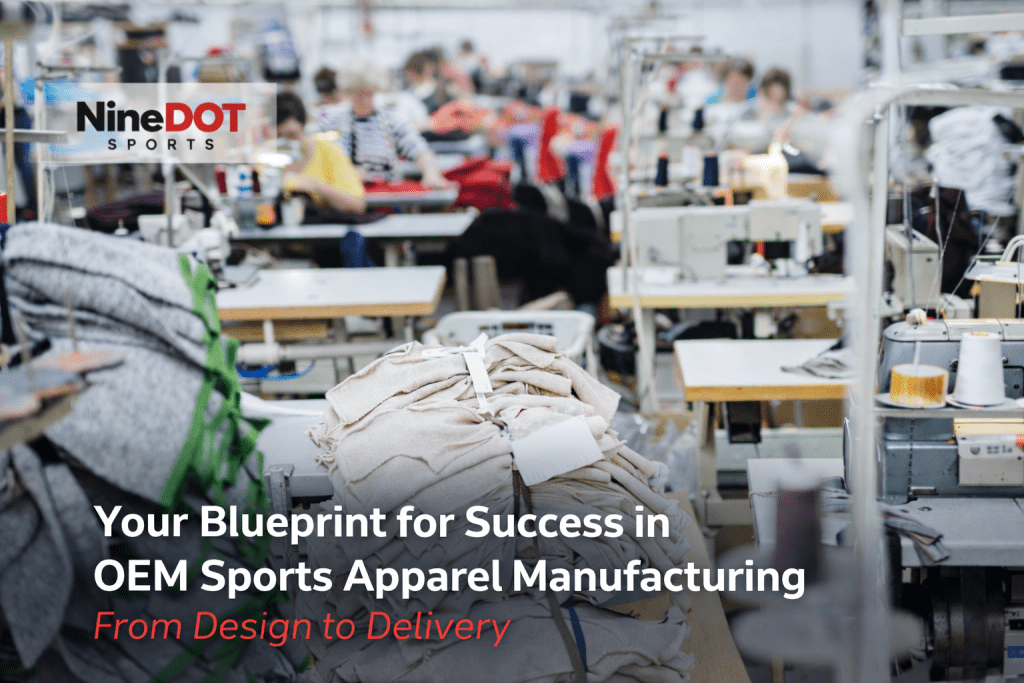
The global sports apparel industry continues to expand as professional clubs, academies, startups, and established brands seek reliable manufacturing partners to bring their vision to life. Behind every high-performance jersey, training kit, or team uniform is a carefully structured production process.
Understanding how OEM sports apparel manufacturing works is essential for brands that want quality, consistency, and scalability.
This guide explains the complete journey — from concept development to global delivery — and outlines how a professional OEM partner ensures performance, durability, and brand alignment at every stage.
What Is OEM Sports Apparel Manufacturing?
OEM (Original Equipment Manufacturer) sports apparel manufacturing refers to a production model where a factory produces garments based on a brand’s specifications. The buyer controls branding, design, and positioning, while the manufacturer handles technical development and production.
OEM differs from:
•ODM (Original Design Manufacturing) – where the factory provides pre-designed products.
•White Label – where products are generic and simply rebranded.
OEM is ideal for:
•Private label sports brands
•Professional teams
•Sports academies
•E-commerce brands
•Distributors expanding product lines
This model offers customization, quality control, and long-term scalability.
Concept Development & Technical Design
Every successful sportswear product begins with a clear concept. At this stage, brands define:
•Target market (professional, academy, training, lifestyle)
•Performance requirements
•Fabric preferences
•Branding elements
•Size range
Professional OEM production requires a technical pack (tech pack), which includes:
•Detailed garment measurements
•Stitching specifications
•Fabric composition
•Color codes
•Logo placements
•Label details
A structured tech pack reduces sampling errors and accelerates production timelines.
Fabric Selection & Performance Engineering
Fabric selection is one of the most critical decisions in sports apparel manufacturing.
Performance sportswear typically uses:
•100% Polyester Interlock
•Polyester Mesh
•Polyester-Spandex Blends
•Microfiber Performance Fabric
Key technical considerations include:
GSM (Grams per Square Meter)
•120–160 GSM for lightweight jerseys
•160–220 GSM for durable training kits
•Higher GSM for winter garments
Performance Properties
•Moisture-wicking
•Breathability
•Stretch recovery
•Shape retention
•Color fastness
For sublimation printing, polyester-based fabrics are essential because they allow dye infusion at high temperatures without cracking or peeling.
Engineering fabric correctly ensures long-term durability and athlete comfort.
Pattern Making & Sampling
Before bulk production begins, a sample must be developed and approved.
This stage includes:
•Digital pattern drafting
•Size grading (XS–XXL or custom size charts)
•Prototype stitching
•Fit evaluation
•Fabric behavior testing
Sampling may require 1–3 revisions depending on design complexity.
Professional OEM factories treat sampling as a precision stage — it determines production efficiency and product consistency.
Production Methods: Sublimation vs Cut & Sew
There are two primary manufacturing approaches in sports apparel production:
Sublimation Manufacturing
•Designs are digitally printed onto transfer paper
•Heat-pressed into polyester fabric
•Ink becomes part of the fabric fibers
Advantages:
•Unlimited color gradients
•No cracking or fading
•Lightweight finish
•Ideal for team uniforms
Cut & Sew Manufacturing
•Fabric panels are cut first
•Logos added via embroidery, screen printing, or heat transfer
•Panels stitched together
Advantages:
•Premium retail appearance
•Structured garments
•Suitable for lifestyle or hybrid sportswear
Choosing the right method depends on brand positioning and end-user expectations.
Quality Control & Compliance
Quality assurance is not a single checkpoint — it is integrated throughout production.
Professional OEM quality control includes:
•Fabric inspection (shrinkage & defects)
•Color fastness testing
•Seam strength testing
•Measurement tolerance checks
•Logo alignment verification
Inspection stages:
1.Raw material inspection
2.In-line production inspection
3.Final pre-shipment inspection
Consistency builds brand trust. Reliable manufacturers implement structured quality protocols for international standards compliance.
Branding & Private Label Integration
Private label integration transforms a product from generic to brand-specific.
Branding elements include:
•Custom woven neck labels
•Heat transfer printed labels
•Hang tags
•Custom packaging
•Barcodes
•Size stickers
Attention to these small details enhances perceived brand value in retail and online channels.
Bulk Production & Lead Times
After sample approval, bulk production begins.
Typical production timelines:
•Sampling: 7–14 days
•Bulk manufacturing: 25–40 days (depending on quantity)
•Shipping: varies by destination
Factors influencing lead time:
•Order volume
•Fabric availability
•Printing complexity
•Branding customization
Professional OEM partners provide realistic production schedules and maintain transparent communication throughout the process.
Final Inspection, Packaging & Global Shipping
Before shipment, final inspections confirm:
•Correct quantities
•Measurement accuracy
•Logo placement
•Packaging standards
Products are packed according to:
•Individual polybags
•Size ratio carton packing
•Custom branded packaging (if required)
Export documentation typically includes:
•Commercial invoice
•Packing list
•Bill of lading or airway bill
Clear documentation ensures smooth customs clearance and on-time delivery.
Why Long-Term OEM Partnerships Matter
Working with a stable OEM partner offers long-term advantages:
•Cost predictability
•Quality consistency
•Production scalability
•Innovation collaboration
•Faster repeat orders
A strategic manufacturing partnership supports brand growth beyond a single order.
OEM sports apparel manufacturing is a structured, multi-stage process that demands technical expertise, precision, and consistency. From fabric engineering to final shipment, each stage influences the performance and credibility of the final product.
For sports brands aiming to scale globally, selecting the right OEM partner is not just a production decision — it is a long-term strategic investment.
If you are planning to develop custom teamwear or launch a private label sports apparel line, working with a reliable manufacturing partner ensures your products meet international performance standards.
Explore professional OEM manufacturing capabilities and request a detailed production consultation to move your project forward.