As demand for custom sportswear continues to grow globally, brands and teams are faced with an important manufacturing decision: should they choose sublimation or cut & sew production?
Both methods are widely used in the sports apparel industry, but they serve different purposes, price points, and brand strategies. Understanding the differences helps brands avoid costly mistakes and align production with long-term goals.
This guide breaks down both processes in detail, helping you determine which method fits your sportswear line.
What Is Sublimation Sportswear Manufacturing?
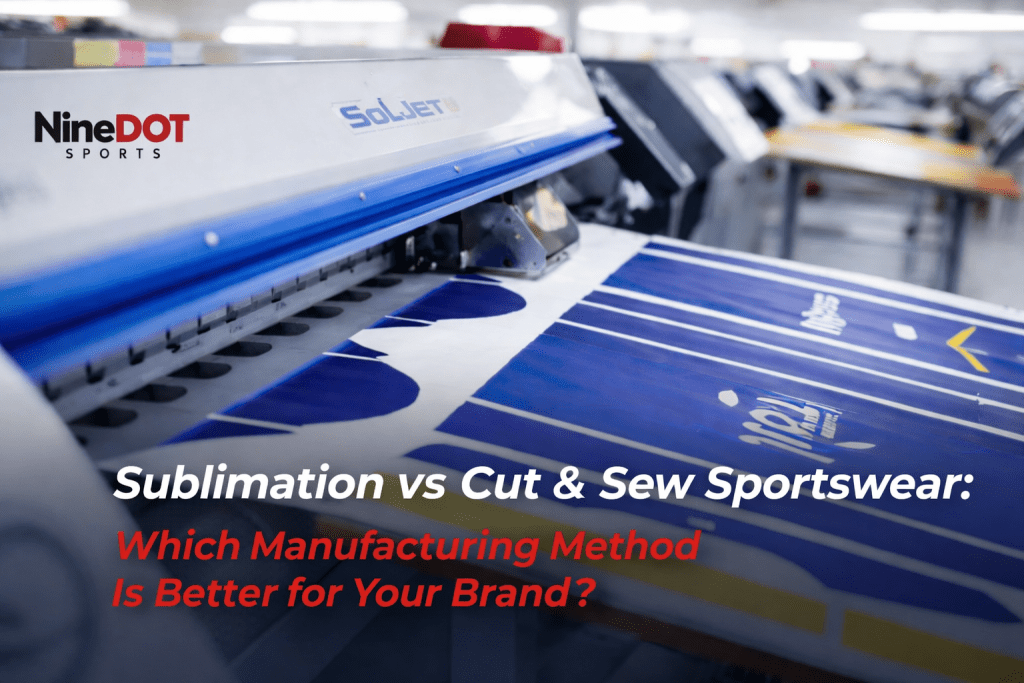
Sublimation is a printing process where designs are digitally printed onto transfer paper and then heat-pressed into polyester fabric. Under high temperature, the ink turns into gas and permanently bonds with the fabric fibers.
Unlike screen printing or heat transfer vinyl, sublimation does not sit on top of the fabric. The design becomes part of the material itself.
This method is widely used for:
•Soccer jerseys
•Basketball uniforms
•Esports jerseys
•Cycling kits
•Team training apparel
Because sublimation requires polyester-based fabrics, it is ideal for performance-driven sportswear.
Advantages of Sublimation Apparel
1. Unlimited Design Freedom
Sublimation allows full-color gradients, complex patterns, and all-over prints without increasing cost per color. Brands can create bold, modern designs without restriction.
2. No Cracking or Peeling
Since ink penetrates the fibers, designs do not crack, fade, or peel — even after repeated washing.
3. Lightweight & Breathable
There is no additional layer of ink on top of the fabric, preserving breathability and moisture-wicking properties.
4. Cost-Efficient for Teams
For bulk team orders with consistent designs, sublimation offers a cost-effective solution with high visual impact.
At NineDot Sports, sublimation production is carefully calibrated to ensure color accuracy, fabric stability, and long-term durability — especially for international teamwear programs.
Limitations of Sublimation
While sublimation is powerful, it has certain constraints:
•Requires high polyester content
•Not ideal for cotton-heavy garments
•Premium polyester fabrics can increase raw material costs
•Limited structure compared to multi-panel fashion garments For brands targeting retail streetwear markets, sublimation alone may not deliver the desired premium construction feel
What Is Cut & Sew Sportswear Manufacturing?
Cut & sew manufacturing follows a traditional garment construction process:
1.Fabric is sourced in rolls
2.Patterns are cut into panels
3.Panels are stitched together
4.Decoration is added (embroidery, screen print, patches, heat transfer)
This method allows for greater structural customization and fabric diversity.
Cut & sew is commonly used for:
•Tracksuits
•Hoodies
•Premium training apparel
•Mixed-fabric garments
•Retail-focused sportswear
Advantages of Cut & Sew Apparel
1. Premium Construction
Cut & sew allows reinforced seams, panel shaping, contrast stitching, and multi-layer fabric integration.
2. Fabric Flexibility
Unlike sublimation, cut & sew can utilize:
•Cotton blends
•French terry
•Fleece
•Nylon
•Performance knits
•Hybrid fabrics
3. Retail-Ready Appearance
Garments feel structured and elevated, making them suitable for lifestyle and athleisure markets.
For brands looking to position themselves in higher-end retail channels, cut & sew manufacturing often supports premium pricing strategies.
Limitations of Cut & Sew
•Higher labor costs
•Longer sampling process
•More complex production planning
•Higher minimum order quantities in some factories
Because each panel is cut and assembled separately, production requires careful coordination and experienced pattern makers.
Cost Comparison: Sublimation vs Cut & Sew
Cost differences depend on:
•Fabric type
•Order quantity
•Design complexity
•Branding requirements
In general:
•Sublimation is more economical for large team orders with consistent designs.
•Cut & sew is more expensive due to labor and construction complexity but offers higher perceived retail value.
Choosing purely based on cost can be misleading. Brands should evaluate positioning, target market, and long-term scalability.
Which Method Is Right for Your Brand?
Teams & Academies
Sublimation is typically the best option for uniform programs due to durability and cost efficiency.
Startup Sports Brands
Sublimation allows lower development risk while maintaining strong visual identity.
Retail & Athleisure Brands
Cut & sew offers elevated construction and broader fabric options.
High-Performance Wear
Often a hybrid approach works best — sublimated panels combined with cut & sew construction.
At NineDot Sports, both methods are managed within structured OEM production systems, allowing brands to scale from teamwear to premium retail collections under one manufacturing partnership.
How Professional OEM Manufacturers Handle Both Methods
A professional OEM partner does more than produce garments. They provide:
•Fabric consultation
•Sampling guidance
•Production timeline management
•Quality control systems
•Branding integration
Manufacturers that offer both sublimation and cut & sew under one production structure can help brands diversify product lines without switching suppliers.
This consistency improves quality control and simplifies future expansion.
Final Considerations Before Choosing
Before selecting a manufacturing method, ask:
•Who is your end customer?
•What price range are you targeting?
•Do you prioritize design flexibility or garment structure?
•What is your long-term scaling plan?
A strategic decision today reduces costly production changes later.
Conclusion
Sublimation and cut & sew sportswear manufacturing each offer distinct advantages. The right choice depends on your brand identity, target audience, and growth strategy.
Understanding the technical and commercial differences empowers brands to make informed production decisions.
If you are exploring custom sportswear manufacturing or planning to expand your private label collection, reviewing your requirements with an experienced OEM partner can clarify the best path forward.
Explore structured OEM manufacturing solutions and request a production consultation to align your brand vision with the right manufacturing approach.